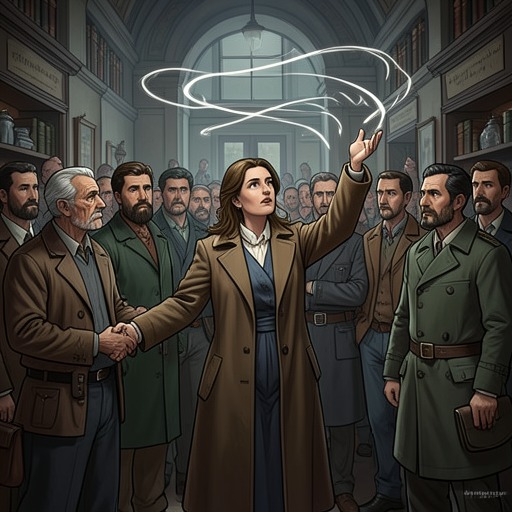
Lizzy Writes to Her Father and Persuades José to Stay
The StaircaseLizzy’s letter to Mr. Enders turns a practical attempt to persuade José to stay into an unwitting confession of her fear that her father no longer wants her. Written for the carpenter to read, it exposes a conflict between the affectionate daughter the letter performs and the abandoned child who hopes, without knowing whether she dares to, that her father still wants her. José’s response brings a limited but immediate consequence: he agrees to remain for a week, while warning Lizzy not to give Elena a home simply for his sake.
The Letter and Its Divided Purpose
Lizzy begins with the conventional salutation “Dear Daddy,” then immediately questions whether she can honestly call her father dear. He has left her when she needed him most, and she explains that the salutation—and, in a sense, the letter itself—is not meant as a sincere act of correspondence. She is writing to show the carpenter, make him happy, and perhaps persuade him to stay. Her stated motive therefore makes the letter instrumental: it is addressed to her father but also composed for José’s eyes and judgment.
The destination adds practical urgency to the emotional appeal. Lizzy sends the letter to Santa Gertrudis Ranch, as her father suggested, and supposes he has arrived there by the time she writes. She hopes he has been given work and that his new position is going well. Yet imagining his working life sharpens rather than settles her anxiety. She thinks he will be away on cattle drives and recalls that a drover could earn more than five thousand dollars a year; from that possibility she draws the fear that he would have no reason to want her with him. The letter reaches toward reunion while rehearsing the possibility that her father has already built a life in which she has no place.
The Feeling the Writing Reveals
The decisive disclosure comes not as a confident appeal but as an admission that writing has clarified what she feels. Until she began, Lizzy did not fully know how she felt; now she confesses, “oh, I hope you want me!” The letter meant to help retain José thus makes visible a different longing: that the father who left her might still choose her. Its emotional force lies in the contrast between the affection suggested by its formal address and the uncertainty she cannot keep out of it.
That uncertainty belongs to a wider experience of being left without the family life she wants. Before seeking José, Lizzy kisses Elena in her cradle and feels love for the helpless baby. She remembers having no brothers or sisters in Independence and finding the condition of being an only child smothering. She had felt that her actions could either make her parents happy or break their happiness forever. Elena’s presence offers the possibility of a sisterly bond, but the letter shows that caring for a child and wishing to be wanted herself are intertwined in Lizzy’s immediate emotional world. She does not present her appeal to José as a settled decision about Elena; she asks him to read the letter first.
José’s Decision and Its Limit
After writing, Lizzy goes to the barn to find José, who is mending his sandals on a bale of hay. She tells him she hopes to convince him to stay and gives him the letter from her apron pocket. His willingness matters because, as he explains, the place is burdened by bad feeling that pulls people under like an undercurrent. Lizzy recognizes the strain rather than disputing it. In that unsettled setting, she asks the carpenter—a stranger whose approval has become important to her—to consider words addressed to her absent father.
José reads slowly, stroking his beard and nodding. He calls the letter good and says it bodes good feeling. His response accepts the letter as an expression with the capacity to change the mood between them, even though Lizzy had begun it for a calculated purpose. He then agrees: “Then I will stay, Lizzy. I will stay the week.” The agreement answers her request, but it is deliberately temporary; the evidence does not make it a promise to remain beyond that week.
José also places a boundary around the favor. He asks whether Lizzy would take on all that responsibility merely to keep him nearby and receive food and lodging for nothing, then cautions her that she must not feel obliged to give the baby a home just for him. That choice, he says, must be something her heart is sure of. The distinction preserves Lizzy’s agency: his decision to stay can give her time and companionship, but it must not become the reason she undertakes Elena’s care.
Consequence and Significance
The scene joins two acts of asking without making them identical. Lizzy’s letter seeks a response from a father who is absent; her direct appeal brings an answer from José, who is present and agrees to stay for a week. The letter also changes its writer’s understanding: what begins as a device intended to please the carpenter becomes a declaration of her own need to be wanted. José’s approval does not resolve her father’s absence, but his careful qualification keeps his help from substituting for a decision about Elena. The result is a short reprieve, an exposed longing, and a choice left where it belongs—with Lizzy.